Daily blogs Engineering
Ship in 2–8 Weeks: What “Production-Grade” Really Means
A demo that wows on day one is not a product. CI/CD, daily staging, and a handoff another engineer can run — that is.
In the fast-paced world of digital product development, speed is often framed as the ultimate competitive advantage. Agencies and internal teams routinely promise to "ship in 2–8 weeks." Yet anyone who has launched software knows there is a massive gap between a flashy prototype that wows stakeholders in a pitch meeting and a resilient platform capable of handling real-world users, edge cases, and continuous traffic.
A flashy demo looks impressive on day one, but without structural integrity it decays into technical debt and crashes under stress. True production-grade software is built differently from the ground up. It delivers speed without compromising maintainability, stability, or security.
Understanding what "production-grade" actually means requires looking beyond the interface to the operational mechanics that keep a project alive long after the initial launch.
The anatomy of a demo that dies after launch
Many rapid software projects suffer from a predictable pattern: they are constructed solely to pass a launch-day presentation. These applications often rely on hardcoded data, fragile local environments, and duct-tape integrations.
When a development workflow prioritizes quick visual wins over engineering discipline, several issues emerge immediately post-launch:
- Brittle codebases. Logic crammed into UI components, so simple updates break unrelated features.
- Lack of error handling. Unhandled API exceptions and missing edge-case validation produce blank screens or useless errors for real users.
- Environment coupling. It works on a laptop or a temporary URL, then fails on standard cloud infrastructure.
- Zero security foundations. Hardcoded API keys, exposed credentials, and absent access controls from day one.
- The knowledge silo. Only the developer who wrote it understands it. No trail for the next team to maintain or scale.
The foundation: daily staging and automated CI/CD loops
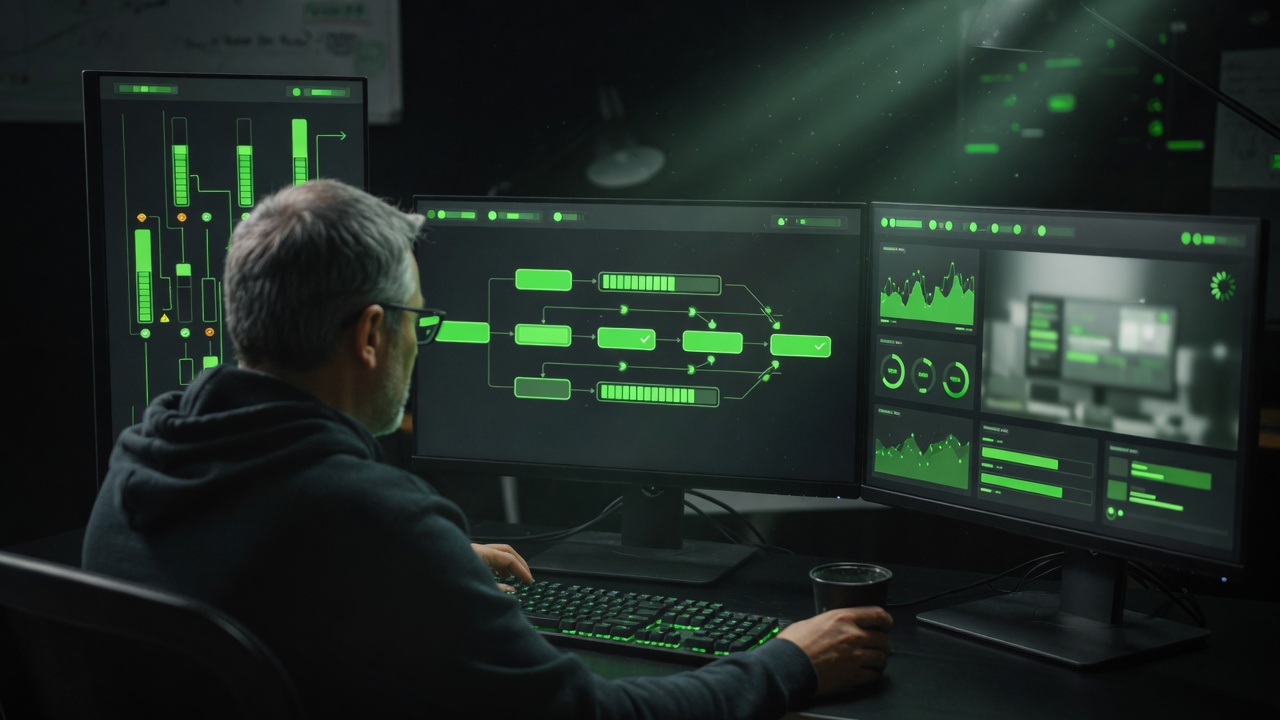
To ship in a 2-to-8-week window without creating a fragile product, engineering teams must automate deployment mechanics from day one. Production-grade delivery relies on continuous integration and continuous deployment pipelines paired with daily staging environments.
- Continuous integration. Every commit triggers automated tests, linting, and build checks. Bugs are caught as code is written, not during a stressful QA pass the day before launch.
- Continuous deployment. Merged code flows to staging without manual intervention. Human deployment errors disappear. The application is always buildable.
- Daily staging builds. Staging mirrors production configuration. Deploying daily gives product owners, designers, and testers a live preview of the exact current state.
- Automated rollbacks. Failure detection instantly rolls back broken builds, maintaining uptime.
- Infrastructure as code. Server configs, environment variables, and cloud resources live in version-controlled scripts — repeatable and scalable.
A short timeline does not mean skipping standards. It means aggressively narrowing scope while keeping architectural quality non-negotiable.
Rigorous standards behind production-grade software
Production-grade applications built on aggressive timelines still hold the line across several vectors:
- Observability and monitoring. Real-time logging, error tracking, and performance metrics are embedded. Teams get alerts from the system, not from user bug reports.
- Data integrity and migrations. Schemas are managed with strict migration tools. Changes are versioned, reversible, and designed to scale.
- Defensive API architecture. External integrations get retry logic, rate limiting, and fallbacks so third-party downtime does not crash the platform.
- Security and compliance. Role-based access control, encryption in transit and at rest, and secure environment-variable management from the initial setup.
- Scalable directory architecture. Modular, logical structure so a new developer can navigate the project without deciphering spaghetti.
Complete documentation and a seamless engineering handoff
The ultimate test of production-grade software is whether another engineering team can inherit the repository, understand it, and safely ship new features on day one. A project that relies on verbal knowledge or unwritten rules is a liability, no matter how fast it was built.
A thorough handoff package includes:
- Comprehensive README. Local setup, tests, builds, and deployment scripts — step by step.
- System architecture maps. Database relationships, API dependencies, external services, and data flow.
- Interactive API specifications. Endpoints, request structures, payloads, auth schemes, and error codes.
- Environment variable blueprints. Every required key, plus guidelines for production secrets.
- Operational runbooks. Backups, credential rotation, and incident response — written so someone else can execute them.
Building for longevity, not just velocity
Shipping software in 2 to 8 weeks is achievable, but true speed is measured by how well the application performs six months after launch. Choosing a production-grade methodology over a superficial demo guarantees that a short delivery timeline results in a permanent business asset rather than disposable code.
By demanding daily staging updates, automated CI/CD pipelines, robust architecture, and complete documentation, you ensure the product not only launches on time, but continues to scale, evolve, and drive long-term value.